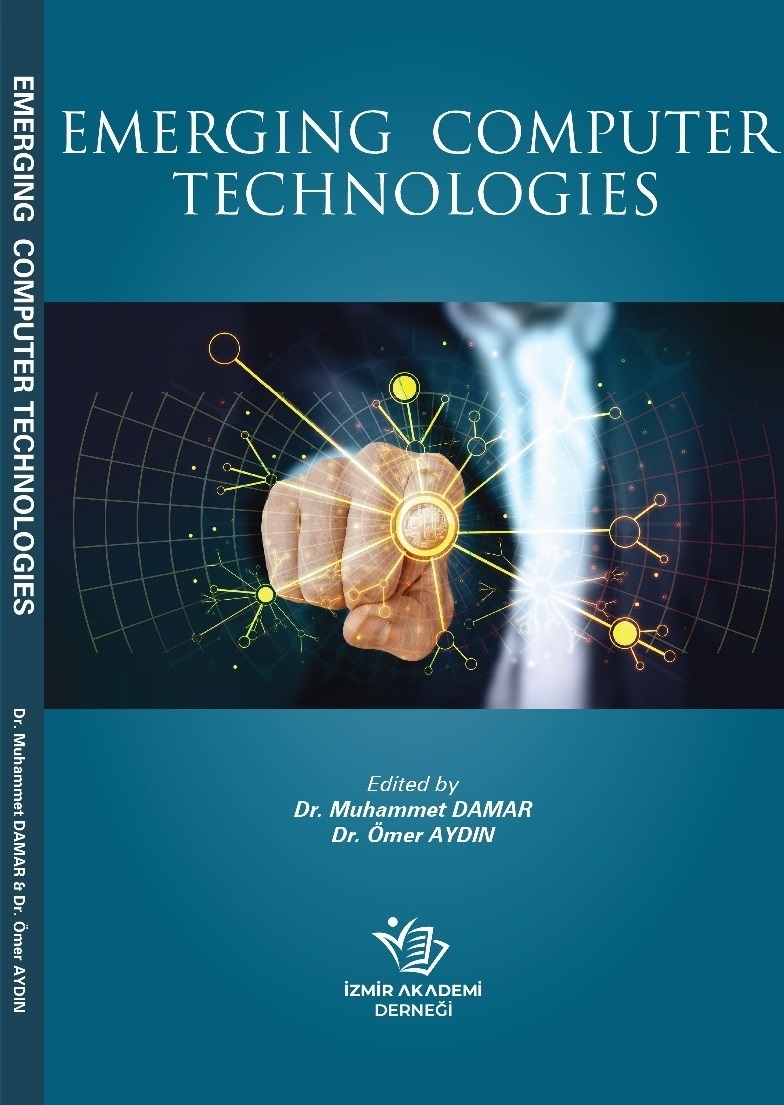
Emerging Computer Technologies
Click Here For Call For Book Chapters Page
Cite (APA)
Overview
- Practical Big Data Learning: A case study on log data analysis introduces Hadoop and MapReduce, offering a hands-on approach to big data processing.
- Securing IoT with AES: Encrypted communication using AES (128-bit and 256-bit keys) is implemented on Arduino-based IoT devices performing edge computing.
- Enhancing IoT Security: A more secure connection between NodeMCU and Blynk is established to address vulnerabilities in IoT-Google Home integrations using AES encryption.
- Innovative Applications: The book introduces MEDGE+, a tool for integrating digital games into education, and DT-DMS, a machine learning-based disaster management system to aid decision-making.
About this book
There is rapid development and change in the field of computer science today. These affect all areas of life. Emerging topics in computer science are covered in this book. In the first chapter, there is a log data analysis case study that aims to understand Hadoop and MapReduce by example. In the second chapter, encrypted communication has been tried to be provided on IoT devices performing edge computing. In this way, it is aimed to make communication secure. Arduino is used as an IoT device. In the encryption process, AES encryption is used with 128-bit and 256-bit key lengths. The third chapter presents a more secure connection between the NodemCU and Blynk, using the AES algorithm. it is aimed to prevent a vulnerability in the connection of Google Home devices with IoT during the Blynk IoT connection phase. The next chapter presents a methodological tool based on an evaluation framework for integration of digital games into education (MEDGE), expanded by adding additional information from the students, MEDGE+. The fifth and last chapter proposes a disaster management system utilising machine learning called DT-DMS that is used to support decision-making mechanisms.
Keywords
Table of contents (6 chapters)
Editors and Affiliations
About the editor(s)
Muhammet DAMAR, Assoc. Prof. Dr., Computer Science, Faculty of Science, Dokuz Eylul University, İzmir, Türkiye
Dr. Muhammet Damar is a computer engineer. He completed his doctorate in business administration in 2020 and received an associate professorship in Management Information Systems in 2023. Although information science is at the forefront of his academic research, Dr. Damar has been involved in many research projects related to the health sector. He has published over 50 articles in Turkish and English and around 130 publications, including papers, articles, books, and book chapters written in English and Turkish. He is a scientist trying to specialize in business informatics, process management, data mining, information science, and health informatics. For the last year, he has been focusing on health informatics, big data analytics, big data systems, business analytics, and especially primary health care services.
Ömer AYDIN, Assist. Prof. Dr., Computer Sciences, Electrical Electronics Engineering, Faculty of Engineering and Natural Sciences, Manisa Celal Bayar University, Manisa, Türkiye
He joined the Department of Electrical and Electronics Engineering at Manisa Celal Bayar University as an Assistant Professor, in 2021. He received a B.E. degree in computer engineering from Istanbul Technical University, Istanbul, Türkiye, in 2007, an M.Sc. degree in Electrical and Electronics Engineering in 2014 and a PhD degree in computer engineering from Dokuz Eylul University in 2019. In 2022, he received the title of associate professor in the field of Management Information Systems. He has more than 15 years of experience in academia and industry. He worked at Dokuz Eylul University as a lecturer between 2013 and 2020. He works at University of Waterloo as a Visiting Researcher between 2024 and 2021. His research interests include artificial intelligence, generative ai, large language models, random number generation, lightweight secuirty and privacy, digital twin, cyber-physical systems. He is also a member of Dokuz Eylul University "Security Research Group" and University of Waterloo's "Waterloo Data and Artificial Intelligence Institute" and the founder of the Izmir Academy Association.
Bibliographic Information
Book Title: Emerging Computer Technologies
Editor: Muhammet Damar, Ömer Aydin
Publisher: İzmir Akademi Derneği (Izmir Academy Association)
Date of Publication: November, 2021
Digital Format: PDF
-
eBook Packages: Engineering, Engineering (R0)
Access Type: Open Access
Copyright Information: CC-BY
eBook ISBN: 978-605-71029-2-8
Edition Number: 1
Number of Pages: VIII + 67 pages
Layout Size: 16x24 cm
Topics: Hadoop and MapReduce, Edge Computing, Secure Connection, Practical Evaluation, Serious Games, Digital Twin, Disaster Management System